Concealed Clips
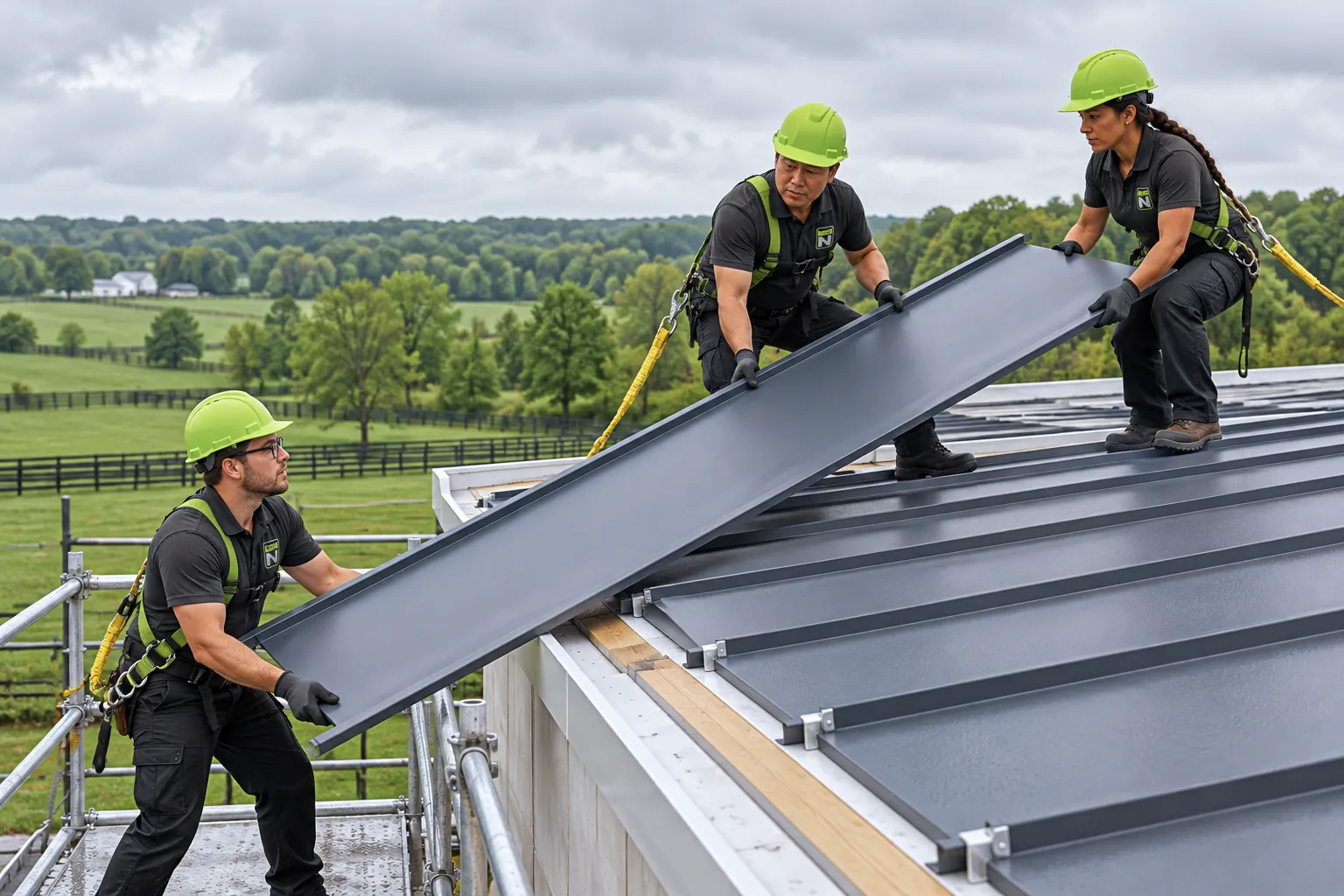
Standing Seam Installation
Twenty-four-gauge panels with raised seams on clips, laid over underlayment on a solid deck, for offices, schools, and churches.
Commercial Metal Roofing · Nicholasville, KY
As a Nicholasville commercial metal roofing contractor, we install, repair, and maintain standing seam and R-panel roofs on shops, offices, churches, and farm buildings.
As a Nicholasville commercial metal roofing contractor, we compare the two panel types and retrofit framing before recommending one for your building.
Up-front price favors R-panel, while concealed clips leave standing seam with far fewer screw holes to look after.
Panels outlast the details that hold them, so a metal roof walk starts with these five.
Screws back out as panels expand and contract, and rubber washers crack in the sun. Each loose screw is a hole straight through the roof.
Sealant between overlapping panels dries out and lets water wick uphill under the lap in wind-driven rain.
Wind lifts trim pieces at the roof edges first, and bent ridge cap opens a path for rain right at the peak.
Unit curbs and walls meeting the roof rely on flashing and counterflashing, which loosen as the panels move around them.
Hail dents, scratched paint, and rust-through holes show up most on thinner panels and on spots where branches rubbed.
Four kinds of metal roof work: two new installs, one conversion, and repairs to the roof you have.
Concealed Clips
Twenty-four-gauge panels with raised seams on clips, laid over underlayment on a solid deck, for offices, schools, and churches.
Exposed Fasteners
Twenty-six-gauge panels screwed through the face with washered fasteners, a fit for shops, barns, and warehouses on steeper slopes.
Ponding Flat Roofs
Light-gauge steel framing builds a new slope over an old flat roof, and panels shed water from it. A structural review of joists and deck comes first.
Existing Metal Roofs
Oversized screws with new washers, matching-profile panel swaps, resealed laps, and reset curb flashing on the roof already up there.
What new panels, trim, and fasteners do for the building.
Clips under the seams replace thousands of exposed screws, leaving far fewer points for water to enter.
Lower-gauge panels resist dents from hail and foot traffic better than thin ones.
PVDF finishes, often sold as Kynar, hold color longer than SMP paint on galvanized or Galvalume steel panels.
Ridge cap, eave and rake trim, and gutters in the same finish keep later repairs blending in as the roof ages.
Retrofit framing turns a flat roof that holds water into a sloped roof that sheds it to new gutters.
Every loose fastener on a metal roof is an open hole. Call and we will walk the fastener rows, trim, and laps before the next storm finds them.
Five steps whether the job is new panels or repairs to the roof you have.
We check fastener rows, laps, trim, curbs, and gutters, measure the slope, and note the panel profile, gauge, and finish already on the building.
Damaged panels are counted and marked on a roof plan.
Slope, building use, and the condition of the existing panels decide between new standing seam, new R-panel, retrofit framing, or targeted repairs.
The panel data sheet lists gauge and paint system.
Underlayment goes over a solid deck, or faced blanket insulation drapes over purlins on open framing. Retrofit jobs start with framing tied to the structure.
Ventilation goes between old and new roofs on retrofits.
Panels go on with clips or washered screws, followed by ridge cap, eave and rake trim, foam closures, and curb flashing in a matching finish.
Snow guards go above entrances where sliding snow lands.
A final walk checks every fastener row, lap, and trim joint, and gutters and valleys get cleared before the roof is signed off.
Leftover screws and metal shavings are swept off the panels.
Work that often shares a property with a metal roof.
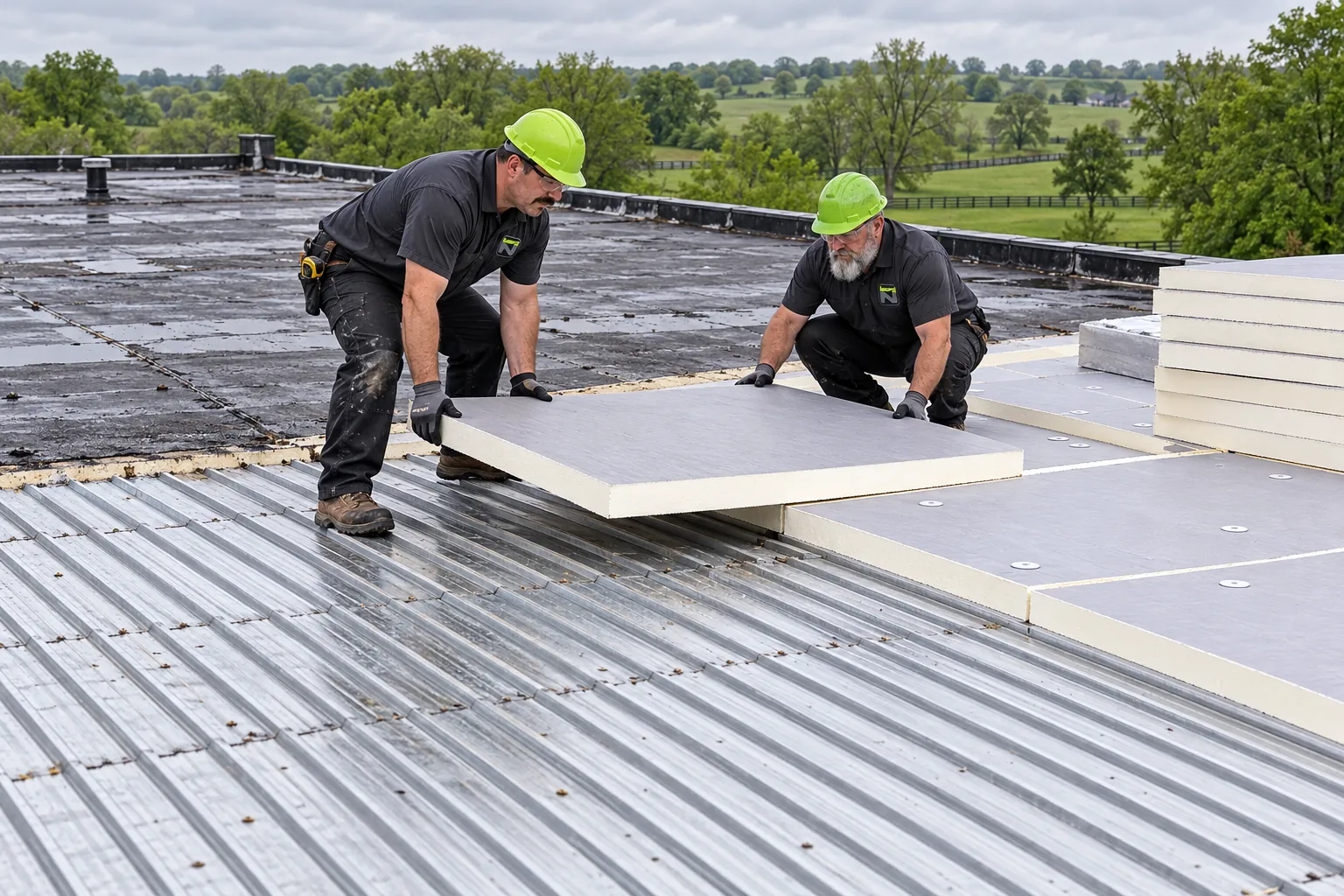
Membrane replacement for the flat sections that sit beside a pitched metal wing.
Flat roofing in Nicholasville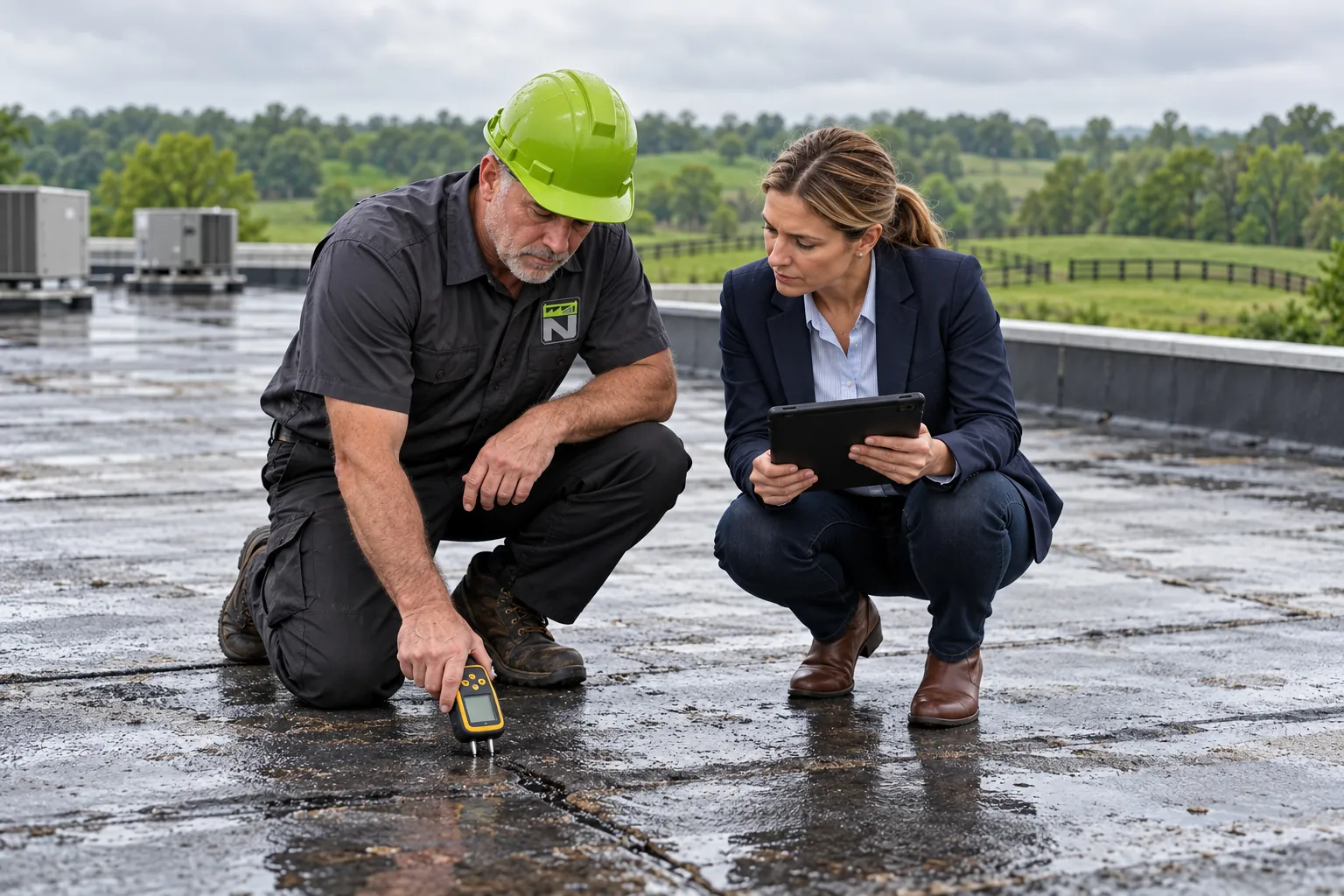
Leak tracing when water shows inside and the source could be a lap, curb, or skylight frame.
Commercial roof repair in Nicholasville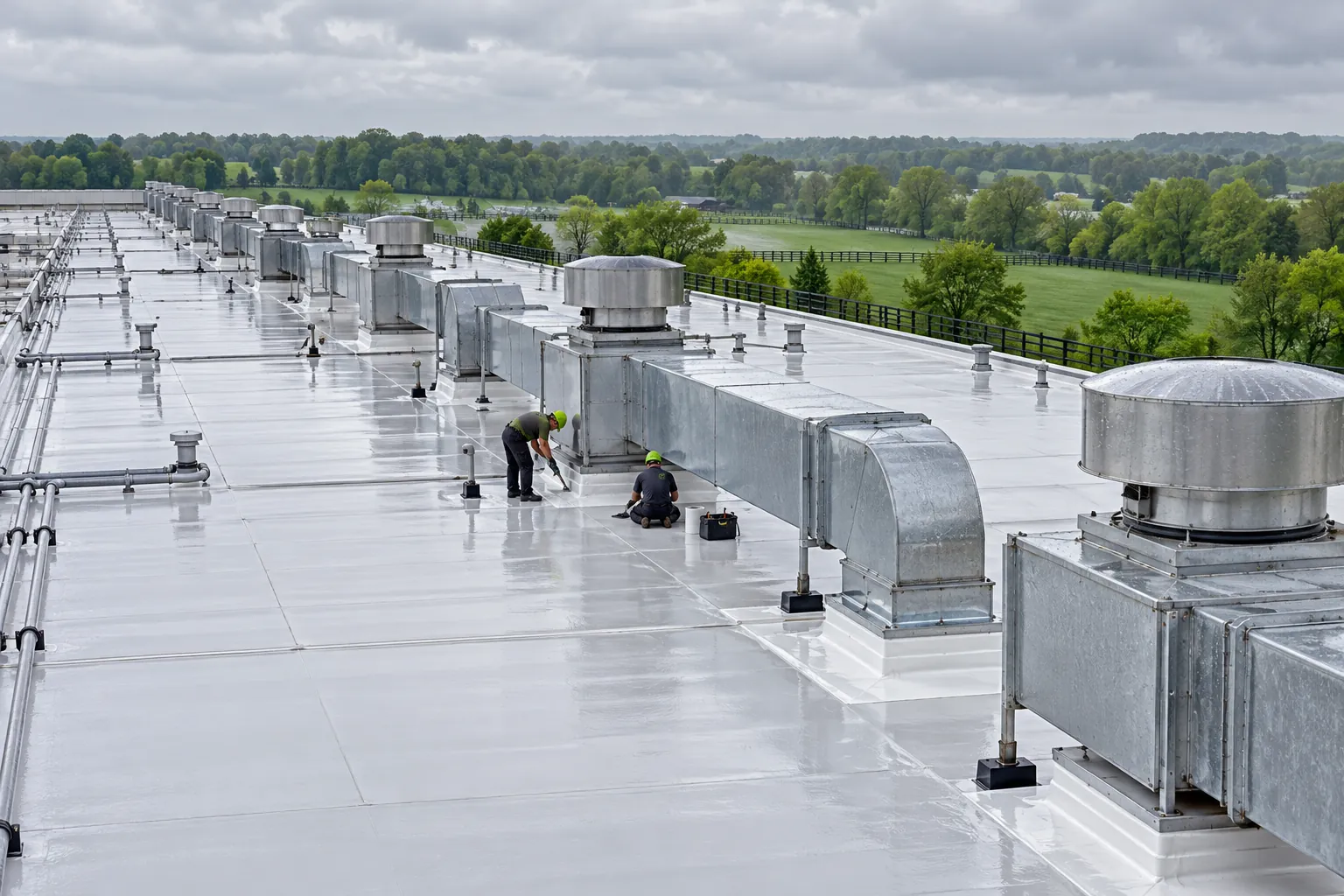
Plant buildings where metal shop roofs share a lot with large membrane roofs.
Industrial roofing in NicholasvilleStanding seam hides its fasteners under raised seams on clips and allows lower slopes on many systems; R-panel is screwed through the face and prefers steeper slopes. Offices, schools, and churches lean toward standing seam, while shops, barns, and warehouses often use R-panel for its lower first cost.
Twenty-four-gauge steel is common for standing seam and 26-gauge for R-panel, with factory paint over galvanized or Galvalume steel. Compare the paint system, since PVDF holds color longer than SMP, plus profile, rib height, and clips. Underlayment goes over a solid deck, or faced blanket insulation drapes over purlins on open framing.
Yes. Light-gauge steel framing attached through the old roof to the structure builds a new slope, and the old membrane stays underneath. The job starts with a structural review of joists and deck, adds gutters at the low edge and ventilation between the roofs, and needs new curbs or relocation for rooftop units.
Each repair goes to the failed detail. A loose screw gets a larger-diameter replacement with a new washer, a hail hole or rust-through gets a panel section in the matching profile, and an open lap gets cleaned out, taped with butyl, and stitch-screwed. Replacement panels match the gauge and paint around them.
A set schedule plus a walk after every major storm. After hail or high wind, check ridge cap and eave and rake trim for lifted pieces, clear gutters and valleys, sweep branches off before they scratch paint, spot-check fastener rows, and inspect sealant at boots, curbs, and skylights.
A measured roof, a solid deck with underlayment, clips fastened at set spacing, and 24-gauge panels seamed over them. Trim, foam closures, curb flashing, and gutters follow in the same finish. Slope gets checked first, since each standing seam system lists its own minimum.
Tell us whether you need new panels or a fix on the roof you have. We start by walking the fastener rows, laps, and trim.
Or call (270) 249-6474
Want a call back about your roof?
Leave a name and number, or call (270) 249-6474 now.